Ask the FIELD™ opens November 2026 Members get first access →

What We Know to Be True

Great engagement work deserves a system worthy of it.

District engagement leaders bring vision, relationships, and deep commitment to this work. The question is rarely about effort or care. It’s about whether the organization is designed to sustain and scale what you’re building, so the families you serve experience consistent, meaningful partnership no matter which school they’re in or who is leading it.

From Personal to Organizational

The most powerful engagement work happens when it moves from one person’s effort into the organization’s design. That shift, from relying on who cares the most to building something that holds, is what makes partnership sustainable and equitable for every family.

From Programs to Practice

Programs are a starting point. Practice is what endures. When engagement is woven into how a district plans, decides, and learns, not housed in a single department or dependent on a single cycle of funding, it becomes part of the culture, not a line item.

From Good Intentions to Smart Design

You already have the commitment. Systemic & Sustainable by Design™ gives you the framework to match it, a practical, field-grounded approach to building the structures, shared ownership, and feedback loops that make your best work last.

Strong relationships are essential. Design is what creates the conditions for those relationships to take root and last.
Michele P. Brooks, M.Ed. · Systemic & Sustainable by Design™

The Framework

Built for the Field, By the Field.

Grounded in the Dual Capacity-Building Framework for Family-School Partnerships (Mapp & Kuttner, 2013; Mapp & Bergman, 2019) and shaped by three decades of district practice, Systemic & Sustainable by Design™ gives you five pillars to organize the work, so engagement isn’t one more thing on your list. It’s woven into how your district operates every day.

Leadership & Values

When leaders make engagement visible in how they plan, decide, and learn together, not just what they say, it becomes everyone’s responsibility.

See the dimensionsHide the dimensions
  • Visible Leadership Commitment
  • Values-to-Practice Alignment
  • Shared Voice, Trust, and Follow-Through

Expectations

Clear standards give the work a spine. When engagement is a district expectation, not a department’s hope, it holds across leadership transitions.

See the dimensionsHide the dimensions
  • Clear and Documented Expectations
  • Embedded Expectations in Daily Work
  • Supportive Accountability

Capacity Building

Families and educators both need to grow, and they grow best when they learn alongside each other. That’s not a nice-to-have. It’s a design requirement.

See the dimensionsHide the dimensions
  • Staff Knowledge and Skill
  • Family, Student, and Community Capacity
  • Organizational Conditions for Capacity

Systems & Structures

Roles, routines, and tools that take engagement off any one person’s back, and build it into how the organization actually works.

See the dimensionsHide the dimensions
  • Role Clarity and Shared Ownership
  • Policies, Protocols, and Decision Pathways
  • Access and Participation Infrastructure

Data & Monitoring

Not just who showed up, but whether it mattered. Engagement data that connects to student learning, tells you if families feel heard, and shows you what to do when they don’t.

See the dimensionsHide the dimensions
  • Meaningful Engagement Measures
  • Equity-Focused Data Use
  • Learning, Adaptation, and Follow-Through

Our Process

Define. Organize. Facilitate.

Every part of the ecosystem follows the same way of working, drawn from decades of leading engagement inside districts.

Step 1

Define

Name the challenge clearly.

Start with an honest, shared picture of where your system stands. The Quick Scan and the Systemic Engagement Navigator™ give your team common language for what is working and what is ready to grow.

Step 2

Organize

Structure the work for impact.

Turn that picture into a plan. Curated tools, SSBD™ Field Guides, and Ask the FIELD™ help you set priorities, clarify roles, and build routines that hold.

Step 3

Facilitate

Bring the right people into the circle.

Move together. Action Labs, capacity-building opportunities, and a community of peers help leaders and teams put the work into practice and sustain it over time.

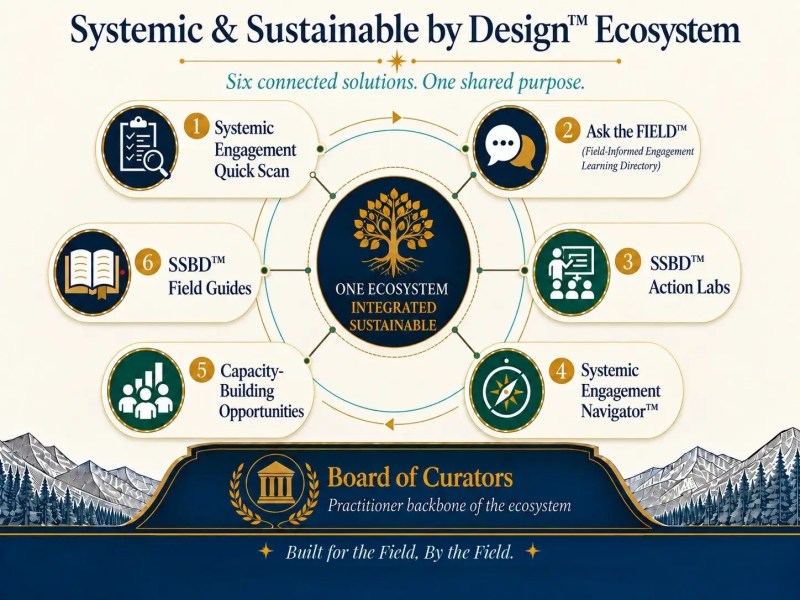
Our Ecosystem

Six connected solutions. One shared purpose.

From engagement activities to engagement systems. Systemic & Sustainable by Design™ is an ecosystem, not a program. Grounded in the Dual Capacity-Building Framework, diagnostics, curated tools, practitioner learning, and a community of peers help district leaders and engagement practitioners move engagement from individual effort to shared, lasting practice.

The Systemic and Sustainable by Design ecosystem: Quick Scan, Ask the FIELD, Action Labs, the Systemic Engagement Navigator, Capacity-Building Opportunities, and Field Guides around one integrated, sustainable center, with the Board of Curators as its foundation

Built for the Field, By the Field.

Capacity-Building Opportunities

Practitioner learning that builds your capacity to lead and manage change alongside peers: Leading Systemic Engagement, four 2.5-hour virtual sessions for leaders, and the Systemic Engagement Series for Teams, five 2.5-hour sessions where teams use their Navigator™ results to apply the framework to a real, current challenge.

January to June 2027See learning opportunities →

SSBD™ Field Guides

Detailed guidance in key areas of the work, giving leaders and teams a shared reference to return to as they design, build, and sustain engagement systems.

In development

Systemic Engagement Quick Scan

A free, five-question snapshot of where your system stands, drawn from the full Systemic Engagement Navigator™ diagnostic. In about five minutes you see your strengths, your areas for growth, and suggested next steps. Anyone can take it; results open with a free membership.

Ask the FIELD™

The Field-Informed Engagement Learning Directory. Bring a real leadership question, choose the situation that fits, and get matched to vetted tip sheets, guides, and tools reviewed by the Board of Curators. It is the grounding component of the ecosystem.

Opens November 2026

SSBD™ Action Labs

60-minute sessions where individuals or teams get guidance using tools in a focused area, so what you learn turns into action right away.

Enrollment opens November 1See learning opportunities →

Systemic Engagement Navigator™

The full diagnostic across 5 pillars and 15 dimensions. The Navigator shows where your district is today and provides a Growth RoadMap, with coaching support to move from where you are to where you want to be.

January 2027

One ecosystem: integrated and sustainable

Each solution stands on its own, and each one is stronger together. The Quick Scan opens the conversation, the Navigator deepens it, Ask the FIELD™ and the Field Guides put vetted tools in your hands, and Action Labs and Capacity-Building Opportunities help you and your team put them to work.

Board of Curators

The practitioner backbone of the ecosystem. A select group of current and former district engagement leaders brings field-tested experience from inside districts to the Navigator™, Ask the FIELD™, and related tools, so every tool reflects what works in real schools and communities.

Start where you are

The practice of building systems that endure.

Take the free Quick Scan, or join the SSBD™ Community free for first access to Ask the FIELD™ when it opens in November 2026.

Take the Quick ScanJoin free →